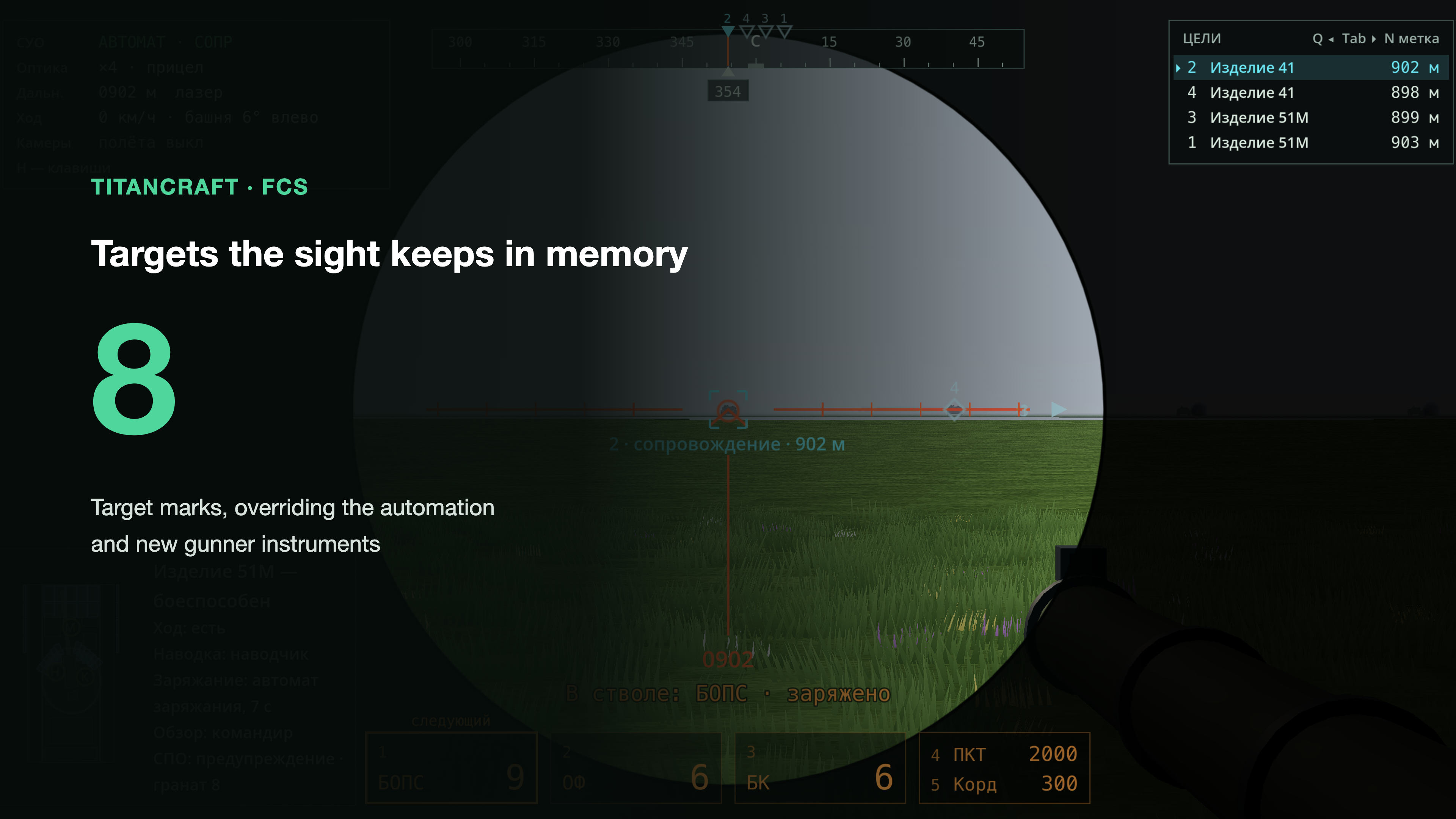
Day nineteen of Titancraft. We built a real FCS — fire control system — for the game's tanks: a rangefinder, a ballistic computer, target tracking, several targets in memory and a way to override the automation. This entry is about how it works: how the reticle becomes a shot, how to keep several targets, and how to override the automation without losing the target.
How the reticle becomes a shot
The gunner places the reticle; the FCS does the rest. The rangefinder measures the range, the computer raises the barrel for the round and moves the point to lead, the turret slews, and the server fires.
The gunner's eye sits to the side of the gun, 0.95 m off its axis. Up close this matters: at 40 m a turret parallel to the sight would miss by 1.4°. So the turret slews not along the sight's ray but onto the firing point from the gun's axis.
The server does not take the client's word for anything. It receives only the aim point, computes the barrel angle itself and checks: is the gun laid, is it loaded, is there anyone to fire it, would the barrel dip into its own hull.
Three modes
V cycles the mode, and the choice is kept after leaving the sight.
| Mode | Who lays the reticle | Range | Barrel elevation | Lead |
|---|---|---|---|---|
| Automatic | the FCS — on the designated target | continuous | computer | from target motion |
| Semi-automatic | gunner | on right click | computer | from reticle motion |
| Manual | gunner | by the reticle scale | none | none |
In manual mode a range scale from 500 to 4000 m appears left of the reticle centre, its own for each round. Put the mark for the range on the target, and the barrel ends up at the right angle.
A knocked-out main sight takes the rangefinder and the computer with it. The mode turns manual, zoom is capped at ×4, dispersion is 4 times wider, and cracks run across the glass.
Rangefinder and lead
The rangefinder is a ray from the eye along the reticle. It first checks tank armour, then walks the ground in 2 m steps and refines the hit by bisection. Water reflects too. Every reading goes to the server: a lased tank learns where the beam came from.
Lead is the target's speed times the time of flight. The FCS takes the target's speed from how its cross moved, smoothed over 0.35 s. Time of flight comes from the round's speed:
| Round | Key | Speed, m/s | Flight to 1000 m, s |
|---|---|---|---|
| APFSDS | 1 | 1600 | 0.63 |
| HEAT | 3 | 1080 | 0.93 |
| HE | 2 | 840 | 1.19 |
Several targets
The FCS used to hold one target. Now you can mark up to 8; one of them is current, and that is the one the FCS tracks.
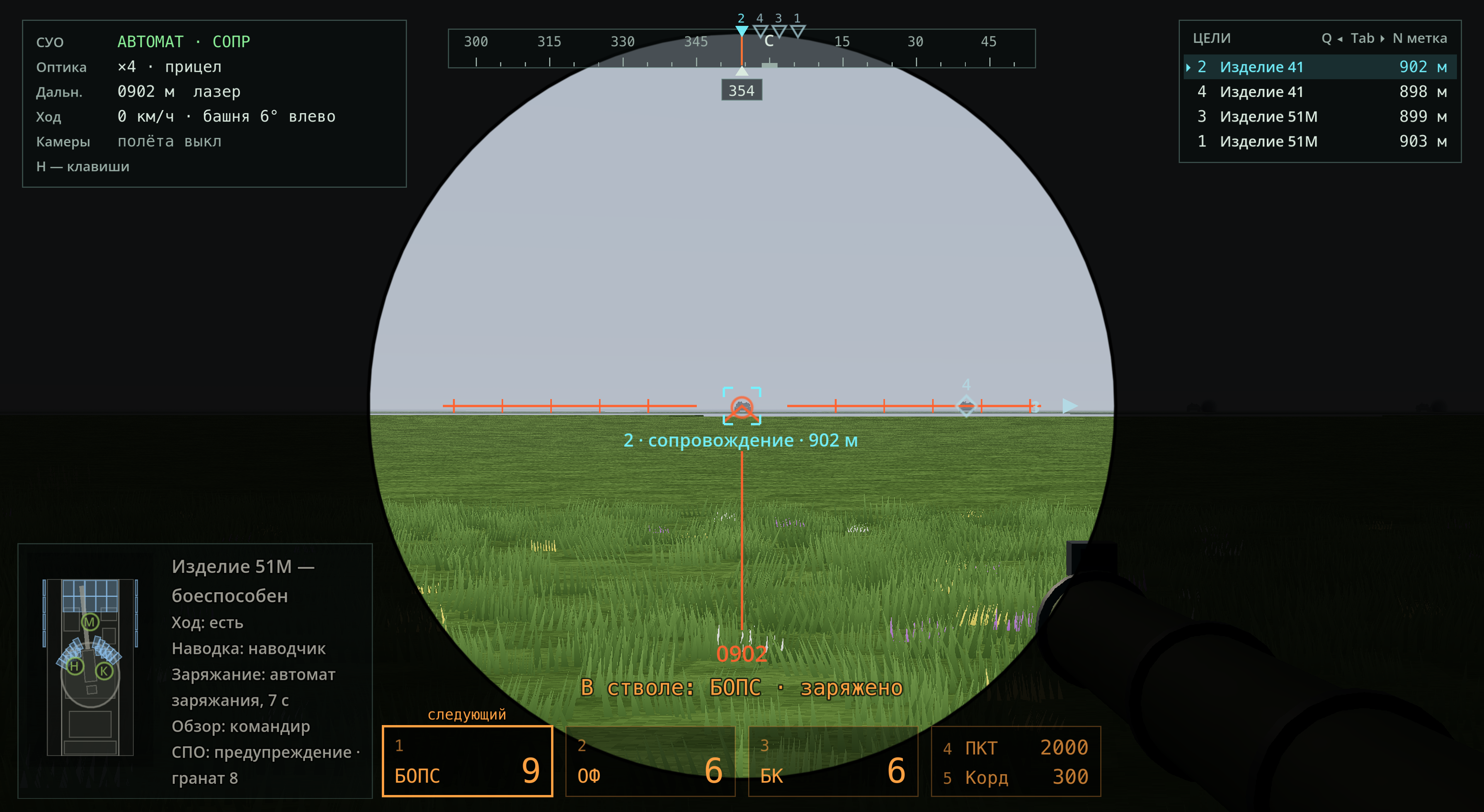
- N on a tank under the reticle marks it and makes it the target. On a marked one, it removes the mark. On empty ground, it drops tracking and keeps the marks.
- Tab and Q step forward and back through the marks. The reticle swings onto the new target smoothly, in 0.45 s.
- Backspace clears all marks.
Stepping goes by bearing, left to right, not in marking order: that way you can see where the reticle will jump. The mark's number is the marking order, and it is the same on the diamond, in the list and on the compass.
A destroyed target stays for another 1.5 s — long enough to see the hit. Then its mark is dropped, and tracking moves to the live mark nearest the reticle.
Overriding the FCS
While the FCS tracks a target, the mouse does not move the reticle — it only shifts the aim point on the target: higher, lower, onto the side. The shift is limited to 0.02 rad on each axis.
Sometimes the automation has to be told to stop. Push the mouse past that limit by another 90 screen points, and the FCS lets go. The target stays selected and marked, the panel shows OVERRIDE, and the gunner lays the reticle from then on.
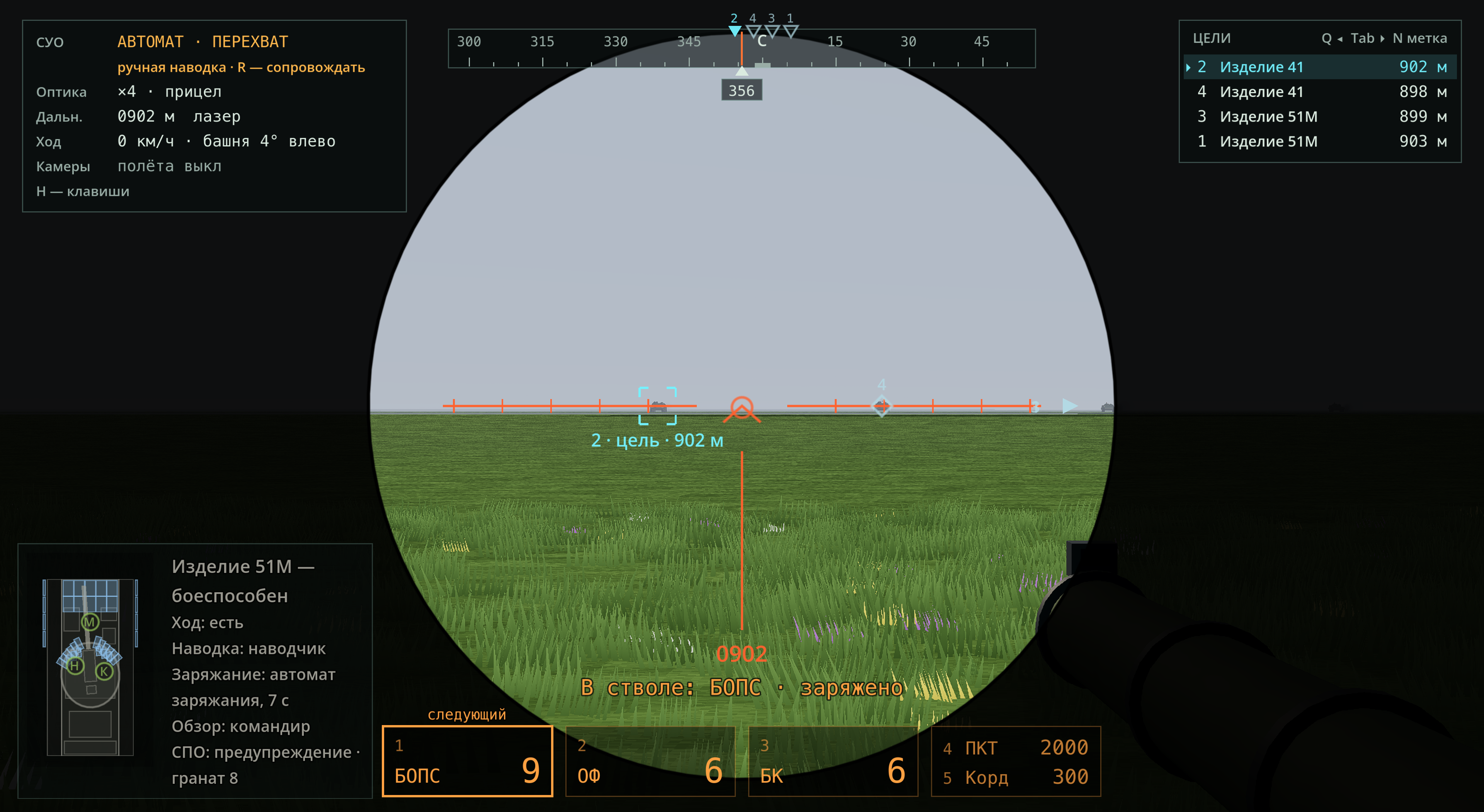
The reticle does not jump on override: the shift is already part of its bearing. Lead starts from the target's motion and then follows how the reticle is moved. Otherwise the first shot at a moving target after an override would miss.
If the target dies during an override, the next one is selected, but the reticle is not taken from the gunner.
In your own tank
In a tank the FCS lays the turret. The reticle moves at once, the turret follows at 0.7 rad/s, and a small circle in the sight shows where the gun points right now.
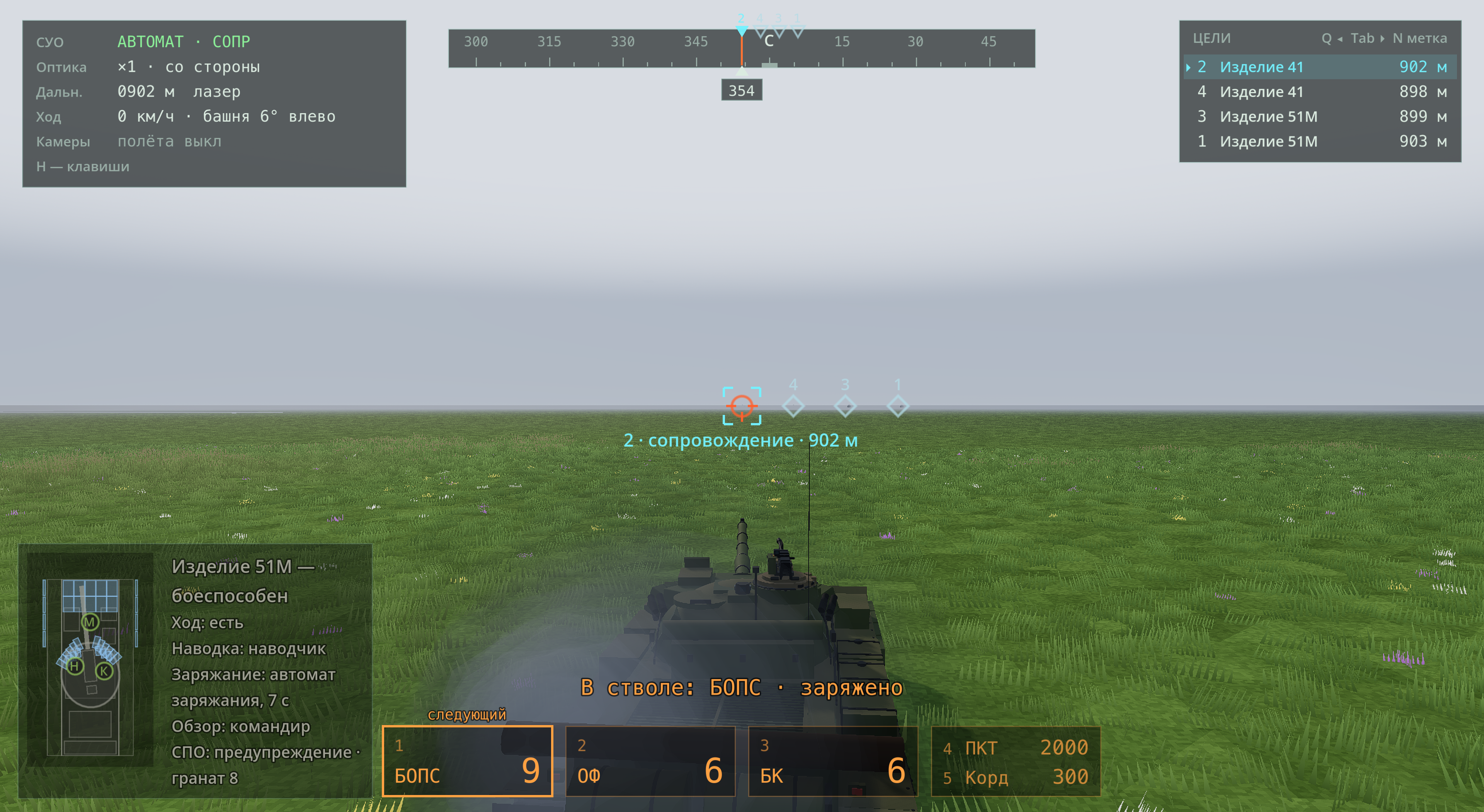
- Until the gun is laid within 1° of bearing, it will not fire — the panel says the turret is catching up.
- Article 51M's autoloader loads in 7 s. The barrel drops to the loading angle of 3° and returns to the sight line, while the sight stays on the target throughout.
- On Article 41 a person loads: 6 s from the turret bustle, 11 s from the hull, 16 s if the loader is out and the commander loads.
- 4 is the coaxial machine gun on the same reticle, 5 the roof AA gun, reticle up to 70°.
- O sets the laser warning mode, G fires a salvo of 4 smoke grenades toward whoever lased you.
New instruments
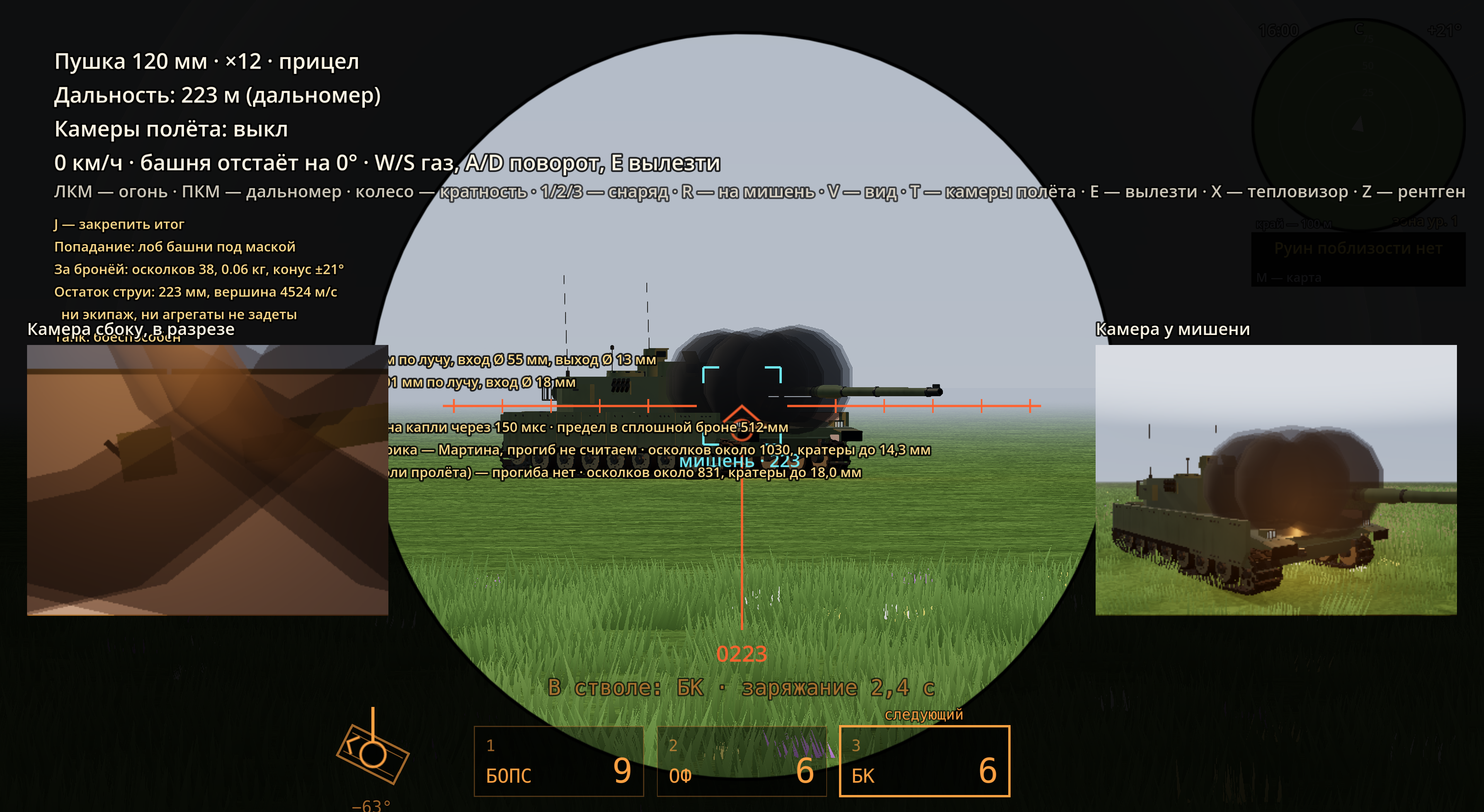
The old HUD grew with every new system: a summary in lines, a key hint running off the screen, a side camera covering the damage diagram, and the hero's minimap reporting "no ruins nearby".
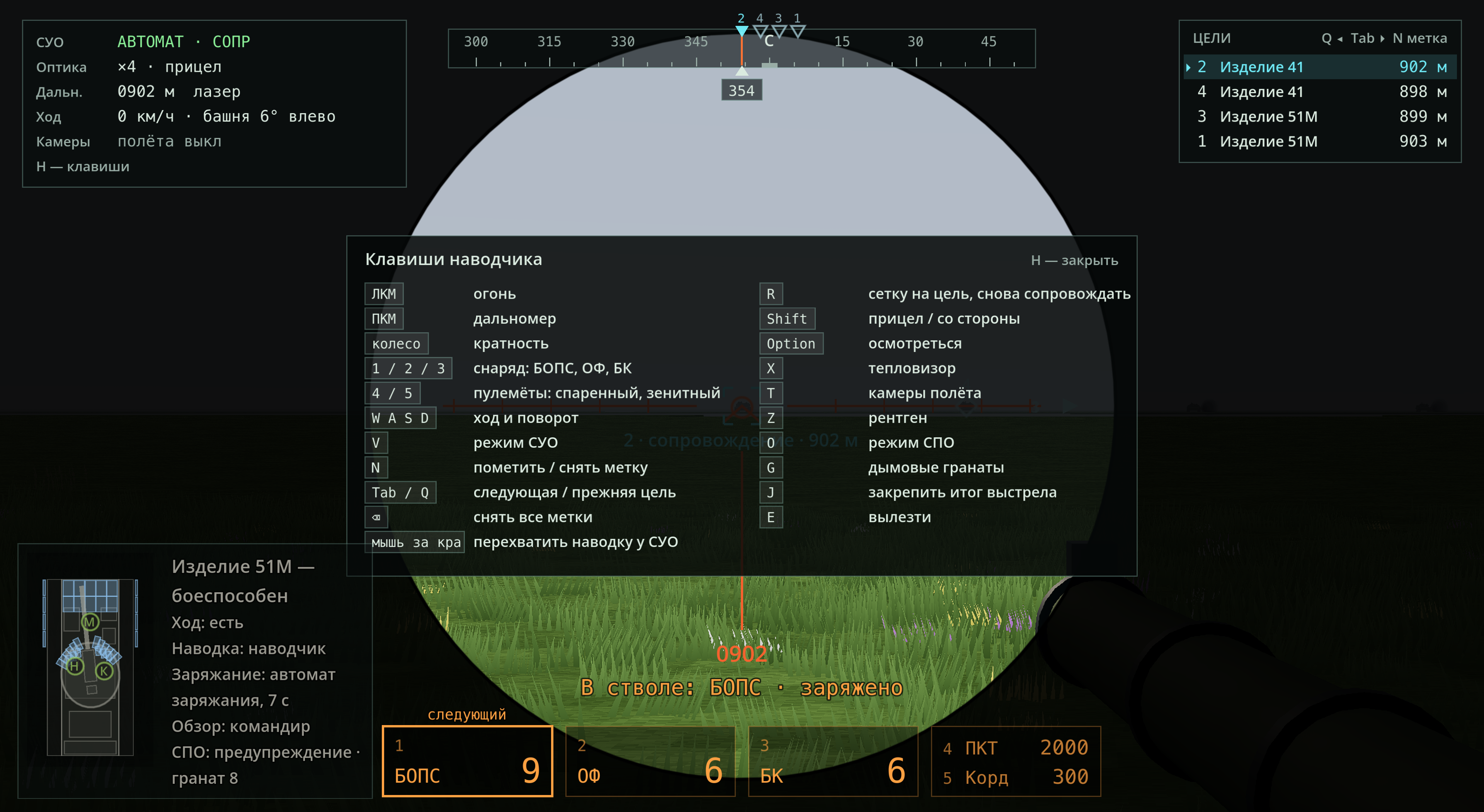
Now each corner of the screen has its job. Top left is the panel: FCS mode, optics, range, speed and turret. On top is a compass with the hull, the gun, the marks and a red triangle for where the laser came from. On the right is the target list, with the shot cameras under it. Bottom left is the damage diagram, bottom centre the ammo rack.
Keys no longer hang in a line: you learn them once instead of reading them every frame. They are all on the card under H.
What's left in the game
- Tracking does not break when the target goes behind a hill or into smoke.
- No tracking through the thermal sight.
- Only the gunner sets marks: there is no commander's sight for designating targets yet.
- Marks are not shown on the map.